From Scans to Stories: The Social Layer Behind Ascendit
social networking logs activity events public profiles
Most social platforms start with posting. You open the app, decide what to share, and then hope someone reacts. Ascendit works in the opposite direction. Social content isn’t something you create separately—it naturally emerges from using the app to track your climbing.
Everything starts with a scan.
When a climber scans a route, they’re not trying to post an update or build a profile. They’re just logging what they climbed. But that single action does more than save personal progress. It links the climber to a shared project, updates activity at the gym, and contributes to the collective history of that route. Without asking anyone to “post,” the system already has something meaningful to show.
This design is intentional. Ascendit treats climbing activity itself as the source of social content, rather than treating social engagement as the primary goal. The result is a community feed that reflects what people are actually doing on the wall, not what they decided to broadcast.
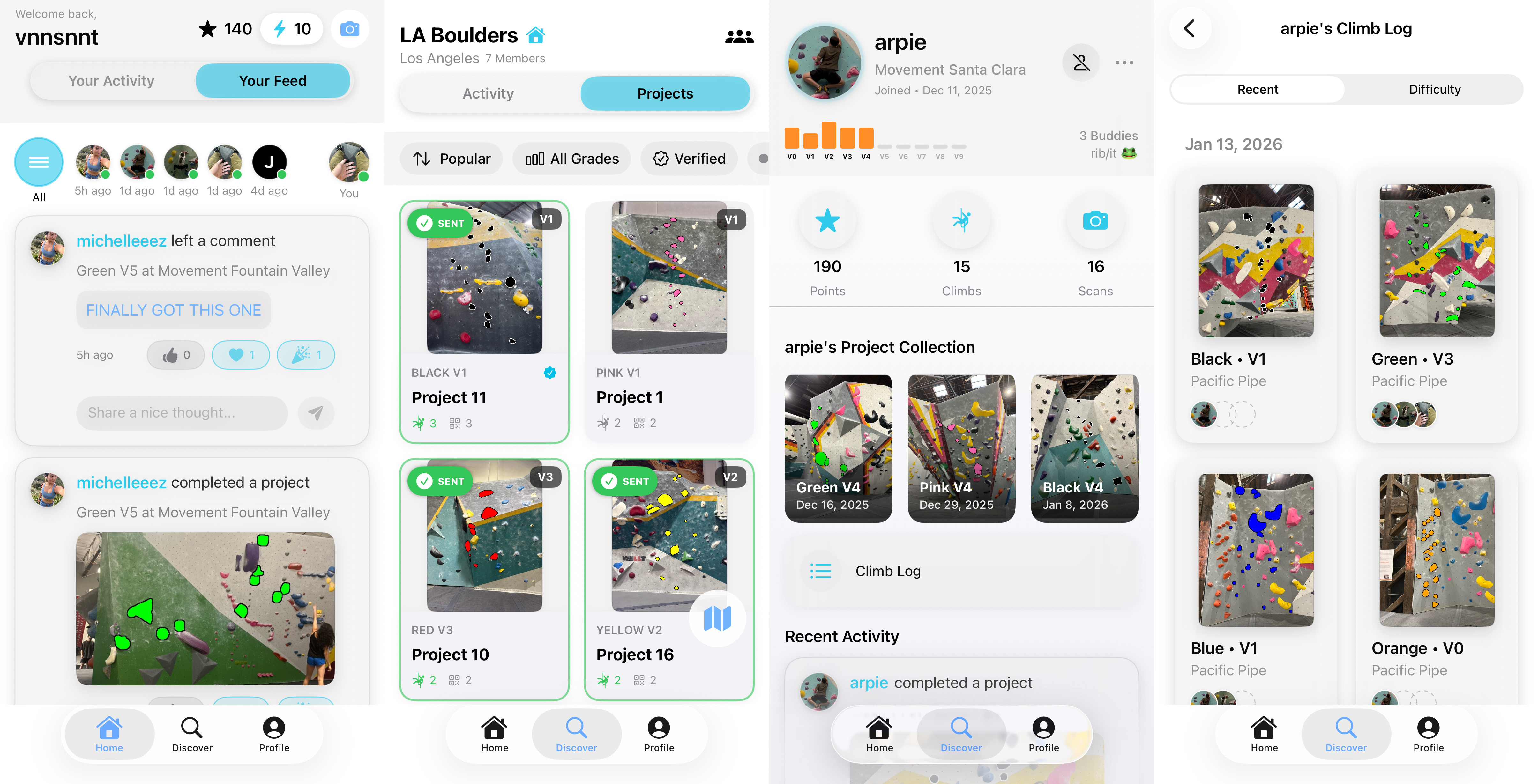
At the gym level, this becomes a real-time activity feed built entirely from scans, verifications, and completions. When you open a gym page, you see recent climbers, active projects, and fresh completions—not curated posts or algorithmic recommendations. You can filter by recent users to see what friends or familiar faces are working on, and jump directly into project pages from the feed.
Because the feed is generated from tracking data, it always stays relevant. There’s no pressure to create content, no need to write captions, and no incentive to exaggerate achievements. If something shows up in the feed, it’s because someone actually climbed it.
From there, social interaction flows naturally into the project directory.
Every project in the directory exists because someone scanned it. Popular routes rise because many climbers complete them. Verified routes stand out because the community has confirmed them. Filters for grade, color, and verification aren’t just browsing tools—they’re reflections of how climbers are engaging with the wall in real time.
Instead of scrolling past posts, climbers browse routes. Discovery happens through climbing data, not through social ranking systems.
When climbers tap into a project, they can contribute tips, verifications, and comments directly on that route. These contributions aren’t detached conversations—they’re anchored to a specific climb that others are actively working on. That keeps discussion focused on improving attempts and sharing beta, not on performing for an audience.
Over time, this activity accumulates into something bigger than individual sessions.
Public profiles are built from the same tracking signals: projects completed, scans contributed, and community interactions. Featured projects let climbers highlight meaningful sends, while climb logs preserve the full history behind the scenes. Grade distributions, recent sessions, and featured collections all grow automatically as people climb, not because they manually curate a feed.
Your profile becomes a story told through real climbing, not through posting behavior.
Even reactions and comments follow this same philosophy. Quick reactions are there to encourage and celebrate, but they’re always attached to real events: a completion, a verification, or a contribution. Conversations happen where they matter most—on the projects themselves—so feedback loops stay tied to improving climbs and supporting each other.
Because everything is grounded in tracked activity, social features stay lightweight. There’s no need for viral mechanics, trending posts, or attention-driven incentives. The app doesn’t ask climbers to perform socially; it simply reflects what they already do physically.
At a system level, this creates a powerful feedback loop.
Tracking fuels projects. Projects fuel activity. Activity fuels community interaction. Community interaction improves route data and discovery.
Each layer reinforces the next, without requiring separate social workflows or content creation habits. Climbers just climb, and the social layer forms around that behavior naturally.
This is what turns scans into stories.
A single scan might start as a personal log, but it becomes part of a shared narrative: who discovered the route, who verified it, who struggled on it, who finally sent it. Over weeks, that narrative captures the life of a climb on the wall, even as the physical holds eventually come down.
Ascendit isn’t trying to turn climbing into social media. It’s trying to preserve what already makes climbing social, and give that energy a digital memory that grows with every session.
Because when community grows out of real activity, it feels less like posting—and more like belonging.